
Canon lens system guide
Canon EF lenses on the R6: adapter costs, crop rules and upgrade choices
What to know before adapting Canon EF lenses to an EOS R camera: adapter compatibility, EF-S crop, and when an RF lens purchase may be worth the added cost.
By WannabeShepherd ·
An adapter can buy time before a full lens-system change
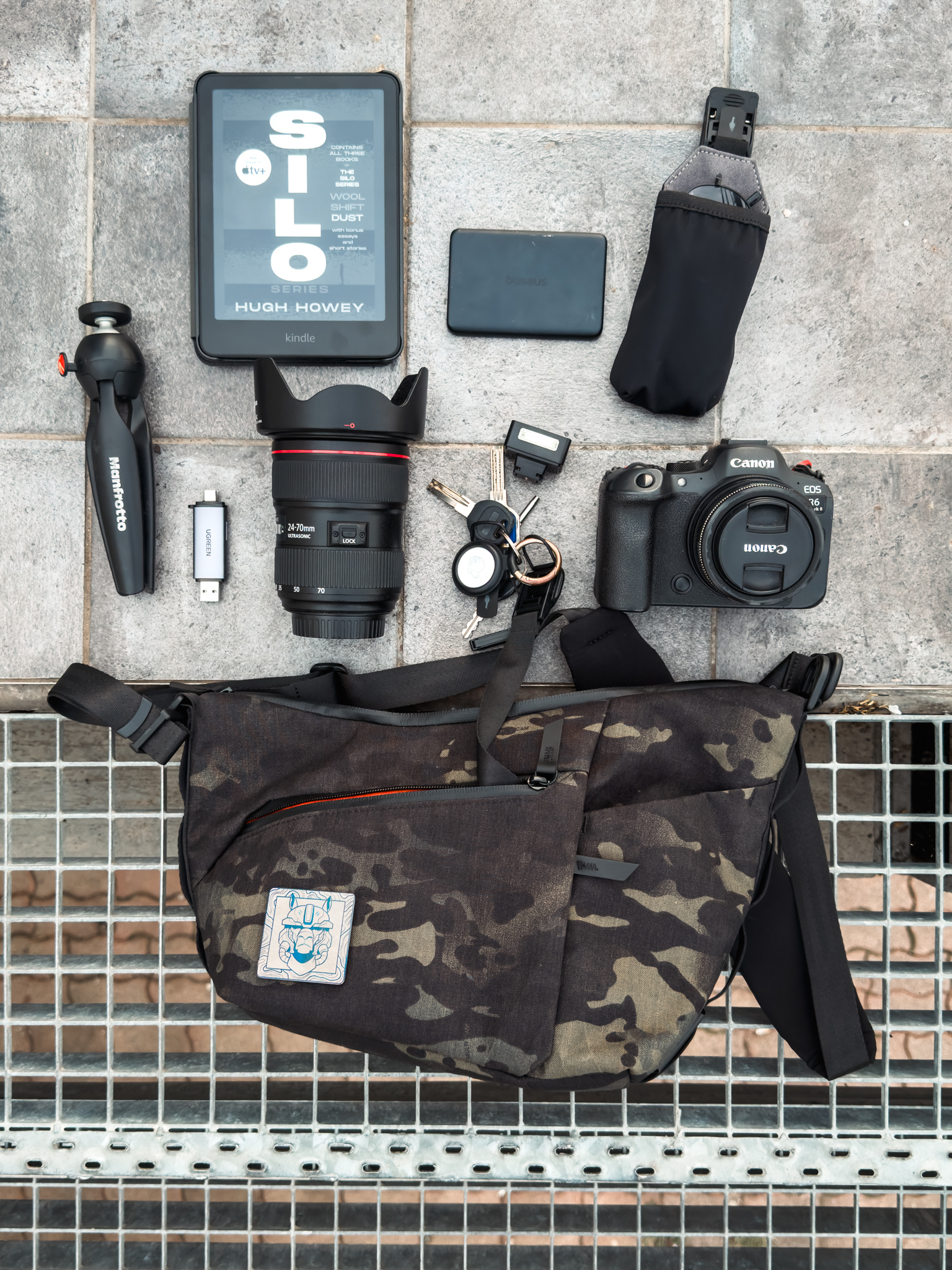
If you already own EF lenses, moving to an EOS R body does not automatically mean replacing them all. Canon documents EF and EF-S lens use with an optional EF-EOS R adapter, with a crop for EF-S lenses. I use EF lenses on my R6 Mark II, including a compact 40mm prime and a 24–70mm f/2.8L II zoom. The guide explains the system choice, not a hands-on test of every adapted lens.
First-hand context: the Canon EOS R6 Mark II, EF 40mm f/2.8 STM, EF 24–70mm f/2.8L II and an adapter are part of my documented kit. The R6 Mark III and RF lens comparisons are based on Canon documentation and listings, not my test.
As an Amazon Associate I earn from qualifying purchases.
| Lens type | Mounting on an EOS R body | Decision point |
|---|---|---|
| Canon EF full-frame | Use the optional EF-EOS R adapter | Keep it if its focal length, condition and performance still suit your work |
| Canon EF-S | Use the adapter; Canon applies an approx. 1.6× crop | Check framing and resolution needs before relying on full-frame coverage |
| Canon EF-M | Not supported on the RF mount | Do not buy an adapter expecting EF-M compatibility |
| Canon RF | Mounts directly to the RF camera | Buy when the lens solves a specific gap; compare handling, size, cost and use |
What the adapter does—and does not promise
Canon’s manual states that EF and EF-S lenses can be used by attaching an optional Mount Adapter EF-EOS R. It says EF-M lenses cannot be used, and that EF-S lenses apply an approximately 1.6× crop to the center of the regular image area. Check the specific camera manual for the model you plan to buy.
Compatibility is a starting point, not a guarantee that every lens feature, firmware version or shooting mode behaves exactly as you want. For a paid assignment, verify autofocus, stabilization, burst or video behavior in your real setup. The lowest-risk upgrade is testing your own lens and adapter on the exact body before selling your current camera.
My kit: compact prime and standard zoom
My R6 Mark II camera bag has a compact EF 40mm f/2.8 STM and an EF 24–70mm f/2.8L II zoom. In a small carry setup, the 40mm takes less room and gives me a simple normal-view option; the zoom covers more framing choices when I do not want to change lenses. These are practical notes about the equipment I own and use, not a controlled comparison against RF versions.
The ALPAKA Flow Satchel review documents the body, adapter and two EF lenses carried together. It describes fit and handling in that bag; it does not claim that an adapted lens is optically equivalent to a newer RF lens.
When should you buy an RF replacement?
Consider an RF lens when your current EF lens has a clear limitation: weight, focus behavior for your use, a missing focal length, weather protection, video handling, or a workflow feature you need. Compare those benefits with the adapter and lens cost, not with a vague promise that newer is always better.
If your current lens gets the images you want, keep using it while you build a shot list of what is missing. Rent or borrow an RF alternative if possible before committing to an expensive focal length. I have not tested the RF 24–70mm f/2.8L against my EF 24–70mm f/2.8L II, so this guide leaves that image-quality question open.
The adapter belongs in your total-cost calculation
Add the adapter to a body-only budget and check whether the model is genuine Canon or a third-party version with the functions you need. Then add a spare battery and suitable cards based on the recording modes you plan to use. If you switch lenses, count the system weight too: lens, body and any filter or hood you carry every day.
Amazon search results can mix adapters, kits, lenses and sellers. Check that the lens says EF or RF as intended, that the adapter is EF-EOS R (not an EF-M part), and that the listing’s seller, condition, return policy and warranty region are acceptable. As an Amazon Associate I earn from qualifying purchases.
Product specifications
Check the manufacturer's current product pages for the exact sold configuration; the untested models above are compared from these published details.
Common questions
Do I need an adapter for Canon EF lenses on an EOS R camera?
Yes. Canon says EF and EF-S lenses use the optional Mount Adapter EF-EOS R on the R6 Mark III.
Can I adapt Canon EF-M lenses?
Canon says the EOS R6 Mark III cannot be used with EF-M lenses.
Does EF-S behave like a full-frame lens on an R6?
Canon notes an approximately 1.6× crop when using EF-S lenses. Check the exact camera manual and make sure the resulting framing and image area suit your work.
As an Amazon Associate I earn from qualifying purchases.