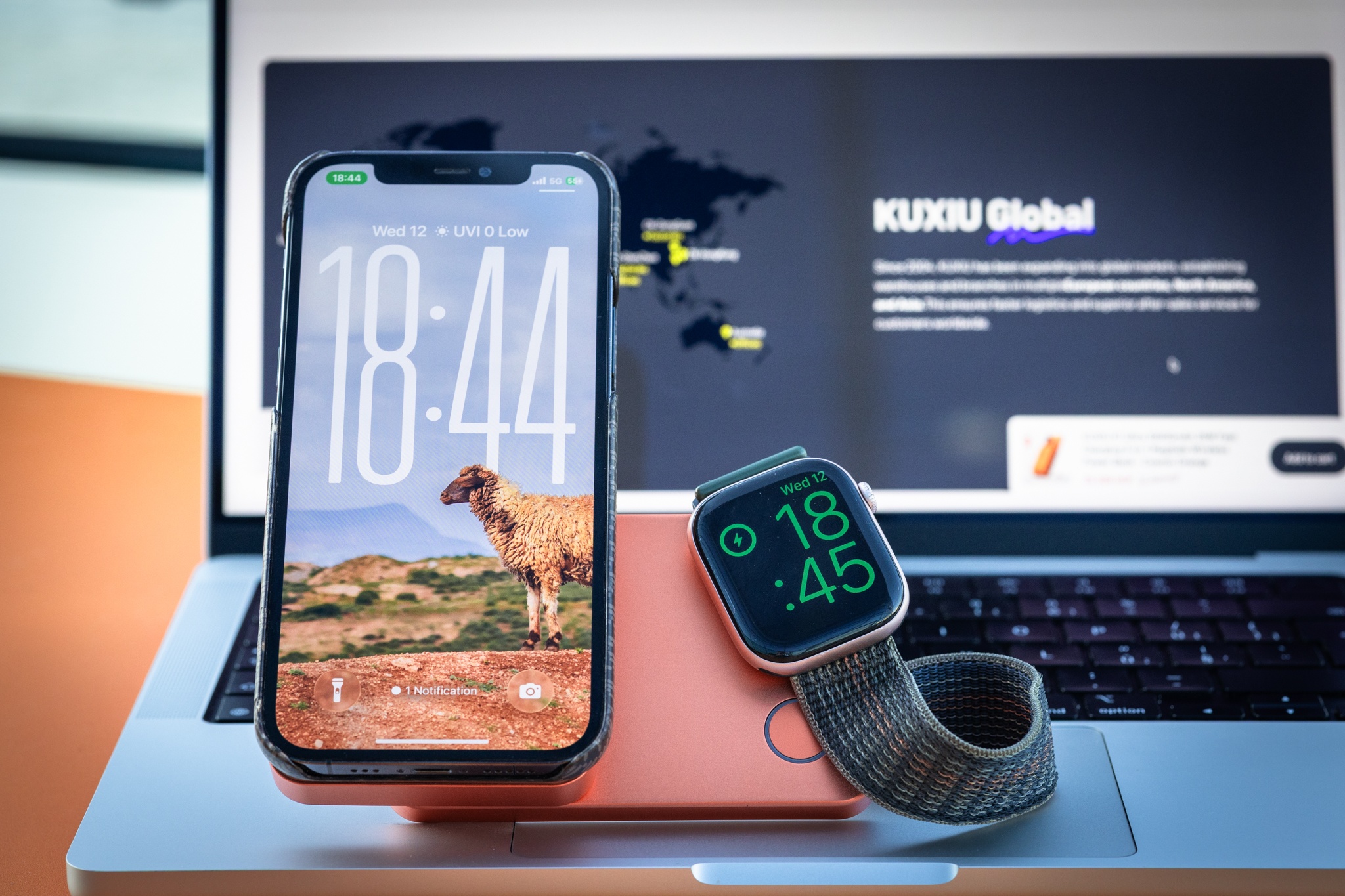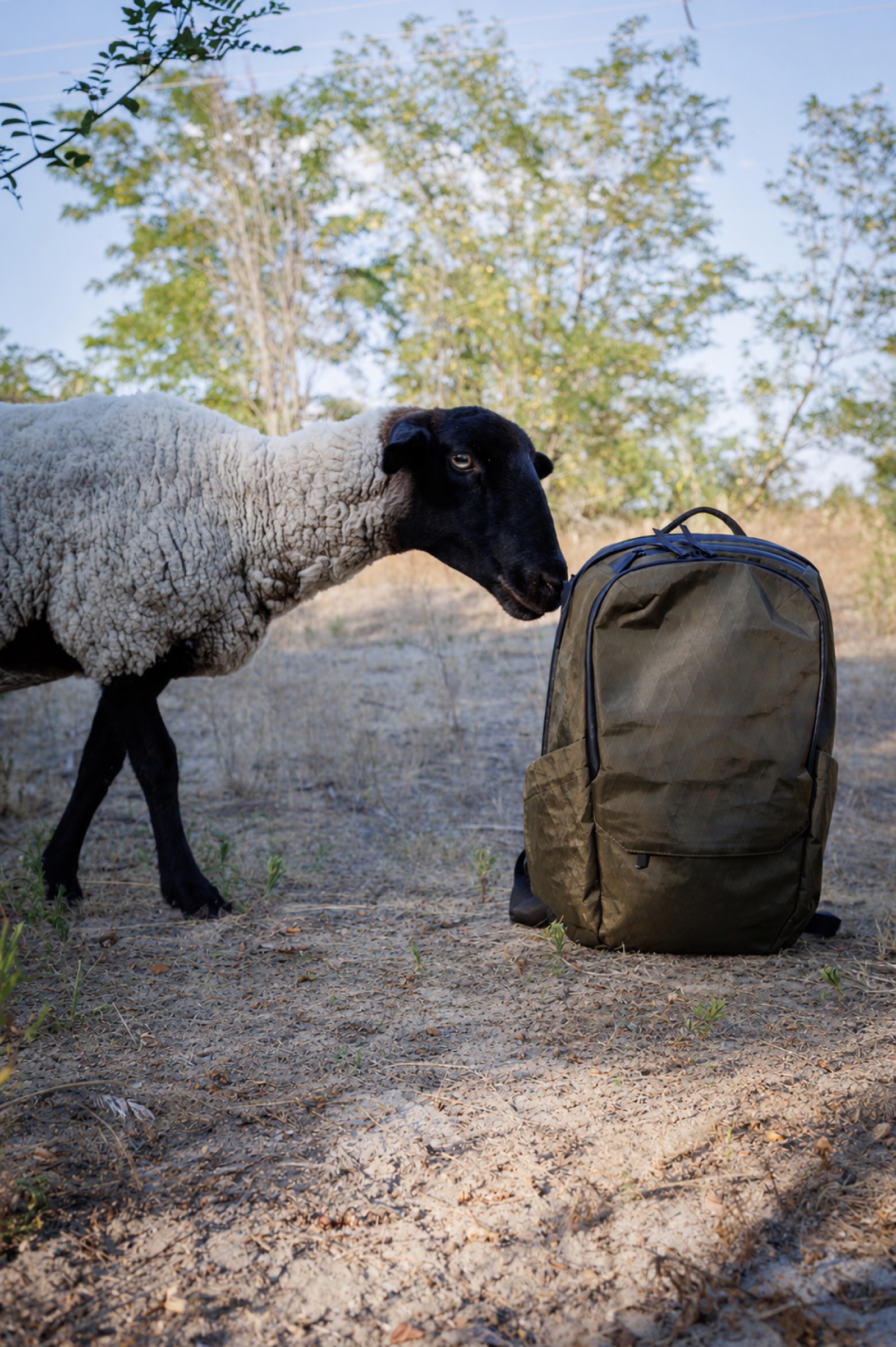
What I carried
- ALPAKA Elements Backpack Pro, Olive Green X-Pac X42
- ALPAKA HUB Keychain
- ALPAKA HUB Sunglasses Pouch
- ALPAKA HUB Carabiner
- ALPAKA HUB ModPanel Mini
- Apple 14-inch MacBook Pro
- Apple iPad Pro
- NuPhy Air75 V3 mechanical keyboard
- Keychron M7 8K Wireless Mouse
- Amazon Kindle
- Canon EOS R6 Mark II
- Canon EF 40mm f/2.8 STM
- Godox V480 flash
- 1-liter water bottle
- Apple AirTag
- Sunglasses, keys, chargers and cables
Design and materials
The first thing I noticed was how light the backpack felt.
I currently use a Peak Design Everyday Backpack V2 20L. This is not meant to be a direct comparison, since the two bags are designed differently, but the ALPAKA feels noticeably lighter both empty and fully packed.
That lower starting weight makes a real difference once the laptop, tablet, camera gear and everything else are inside.
I really like the Olive Green X-Pac material. The color works well with the black details, while the diamond pattern gives it a technical look without being too loud. Together with the bright orange interior, the whole backpack has a tactical, techwear style that I personally love.
The materials, stitching and zippers all still look perfect. I have not noticed loose threads, scratches or early wear.
One detail looks slightly strange to me. The stitched ends of the lower shoulder strap adjustment sections face outward instead of toward the back. It does not affect comfort or function, but visually it feels like the seam should be facing the other way.
Shape and size
The Elements Backpack Pro is rated at 24 liters, so I expected it to look larger and deeper than my 20-liter Peak Design based on the product photos.
In person, the difference is much smaller than I expected.
When it is not fully packed, the profile stays surprisingly slim. Even when filled, it does not turn into a bulky box on my back.
Internal reinforcement gives the backpack enough structure to keep its shape, but it still feels less rigid than my Peak Design. I prefer that for normal city use, university, cafés and shorter trips.
One of the biggest practical surprises is that it stands on its own.
I constantly struggle with backpacks falling over at university unless I lean them against a table or wall. The ALPAKA stays upright when normally packed and does not immediately tip to either side.
It can also stand while empty, although it is less stable that way.
Comfort and weight distribution
The weight distribution is excellent.
The shoulder straps feel more comfortable to me than those on my Peak Design, and the padded back panel sits nicely against my spine. I also feel like my posture is slightly better while wearing it.
I carried it for several hours with a fairly heavy load. Eventually I could feel the weight, which is unavoidable with a laptop, tablet, camera gear and other accessories, but it remained wearable and balanced.
The lower empty weight helps a lot here. I am carrying my equipment rather than wasting part of the load on a heavy backpack structure.
The magnetic sternum strap is one of my favorite details.
It is incredibly easy to connect with one hand. You just bring the two sides together and the magnet guides them into place. Opening it is equally quick.
The strap can also be removed completely if you do not use it.
Laptop and tech organization
My 14-inch MacBook Pro fits easily in the padded laptop compartment, with enough room for a 16-inch model as well.
The compartment in front of the laptop sleeve is also useful. Depending on the day, it can hold:
- An iPad
- A Kindle
- A compact travel keyboard
- Documents or a notebook
There is also a narrow internal organizer that happens to fit an Apple Pencil perfectly.
The bright orange lining is not only visually interesting. It also makes small black accessories, cables and adapters much easier to find than they would be inside a dark interior.
There are plenty of pockets, and you can organize the same load in several different ways.
The downside is that the internal pockets share the same overall volume. When everything is full, items stored in one section push into the space of another. The backpack can become tighter sooner than the number of compartments might suggest.
External pockets
The small top pocket is ideal for things that need to be reached quickly, such as:
- Sunglasses
- Passport
- Earbuds
- Small everyday items
The lower front pocket works well for a power bank, compact mouse or other flat accessories.
Both external bottle pockets hold their contents tightly. My 1-liter bottle stayed secure, even when the backpack was tilted sideways.
That is a meaningful improvement over my Peak Design, where the bottle can slide out much more easily when the bag is laid on its side.
I do miss having a side handle. It would make it easier to lift the backpack from a car seat, overhead compartment or luggage rack.
Capacity and fit: what this review establishes
The 24-liter figure is ALPAKA’s capacity rating, not an independent usable-volume measurement in this review. Structured compartments and loaded internal pockets share space; a litre rating alone does not establish that a particular device or travel loadout will fit.
Several owners in the Reddit discussions described the usable space as smaller than the rating suggests. Their experiences are a reason to check your loadout, not a measured replacement capacity. This review does not establish a universal 20- or 22-liter usable volume.
- Compare the device’s full width, height and thickness with its case attached—not just its screen diagonal.
- Check compartment openings and zipper clearance as well as the space inside; account for adjacent loaded pockets.
- For a camera kit, allow space for padding or dividers rather than treating a successful fit as proof of impact or scratch protection.
My comfort observations apply to the outings described here. They do not establish multi-day travel comfort for every body size or load. Rain resistance and exact usable interior dimensions still need separate measurements.
Camera use
The Elements Backpack Pro can carry camera equipment, but I would not use it as a dedicated camera bag without an insert.
I tested it with my Canon R6 Mark II, EF 40mm f/2.8 and Godox V480 flash. They all fit, but smaller pieces can get lost inside the large main compartment.
For one camera with a compact lens, it works well enough. There is still plenty of room for clothes, a laptop and other essentials, which makes it a good option for a weekend trip where photography is only part of the plan.
For carrying several lenses or frequently changing equipment, I would still prefer a proper padded camera organization system.
Travel features
The main zipper pulls can be brought together and locked, which is useful when travelling with a laptop, camera or other valuable items.
The luggage pass-through works, but the backpack has to be placed horizontally on the suitcase handle.
I understand the likely reason. The backpack might sit too high if mounted vertically. Still, I would prefer having both options.
When the backpack is horizontal, there is more chance of something falling from an open side pocket. The bottle pockets are tight enough to reduce that risk, but vertical mounting would feel safer.
HUB accessories
The HUB system is a genuinely clever idea.
The magnetic clips are satisfying to use, but the mechanical locking part keeps the accessories secure. They do not feel like they will detach accidentally.
I used the HUB system with:
- Sunglasses
- Keys
- Small accessories
- The HUB Carabiner
The HUB Sunglasses Pouch works well on the shoulder strap and keeps the glasses easy to reach without taking up pocket space.
The HUB Carabiner is sturdy and useful for keys or anything else I want to attach temporarily. The quick-release mechanism is much easier than repeatedly opening a normal carabiner.
I would like to see more HUB attachment points on the outside of the backpack.
At the moment, the main options are on the shoulder straps. Adding several obvious loops could make the exterior too busy, but I think one or two could be hidden without damaging the clean design.
For example, the lower front zipper is covered by an extra fabric flap. A discreet attachment point could probably fit underneath it.
HUB ModPanel Mini
The separate HUB ModPanel Mini may be my favorite part of the accessory system.
I attached it to my refrigerator and now use it as a fixed place for my keys, sunglasses and whatever is currently connected to the carabiner.
I am very absent-minded and usually drop these things wherever I happen to be. Then I have to search for them in the morning when I am already in a hurry.
I am trying to build a habit of putting them on the ModPanel every time I get home. It is a simple idea, but it solves a real everyday problem for me.
Weather resistance
I was not able to test the backpack in rain.
As the photos probably make obvious, Central Europe is currently going through a very dry period, so there was hardly any chance of getting caught in proper rain.
Hopefully autumn will provide a better opportunity to see how the X-Pac material and covered zippers handle wet conditions.
What I liked
- Very good weight distribution
- Lower empty weight than my Peak Design backpack
- Comfortable shoulder straps and padded back panel
- Magnetic sternum strap is extremely easy to use
- Slim profile when lightly packed
- Does not look excessively bulky when full
- Stands upright on its own
- Excellent X-Pac material and Olive Green color
- Bright orange interior makes items easy to find
- Plenty of organization options
- Spacious laptop compartment
- Tight bottle pockets that securely hold a 1-liter bottle
- Lockable main zipper pulls
- HUB accessories are practical and well designed
- HUB ModPanel Mini gives the system a useful life outside the backpack
What could be improved
- No side handle
- Luggage pass-through only works horizontally
- Internal pockets take space from each other when fully packed
- Not ideal as a camera bag without a padded insert
- More discreet external HUB attachment points would be useful
- The outward-facing shoulder strap adjustment seams look slightly odd
- I would also like a slimmer version with the same external bottle pockets
The slimmer version I would like to see
For full-day use, travel and mixed tech carry, the 24-liter size works well.
For quick trips to a library, university or café, it can be more backpack than I need. I would love a slimmer version designed around:
- Laptop
- Water bottle
- Charger
- Mouse
- Kindle or iPad
- A few daily essentials
ALPAKA already makes slimmer bags, but the external bottle pocket is essential for me. A narrower Elements-style backpack that kept the same bottle pockets, materials, orange lining and HUB compatibility would be very appealing.
Overall
The Elements Backpack Pro feels much lighter and less bulky than I expected from a structured 24-liter backpack.
Its strongest points are the comfort, weight distribution, organization and slim profile. It carries a large amount of equipment without looking oversized, and the lower empty weight is especially noticeable compared with my Peak Design Everyday Backpack.
It works best for my everyday tech carry, university, cafés, city use and weekend trips. It can handle a small camera setup too, although dedicated camera users will probably want an insert.
The magnetic sternum strap and HUB system are more than small gimmicks. Both became useful parts of how I use the backpack, and the ModPanel Mini has even improved how I organize my keys and sunglasses at home.
There are a few things I would change, especially the missing side handle, horizontal-only luggage pass-through and limited external HUB mounting points. None of them have stopped me from enjoying the backpack.
It feels technical and distinctive without being flashy, carries weight comfortably, and stays much slimmer than the 24-liter capacity suggests.